
Yonder Plan
Explore by yourself.
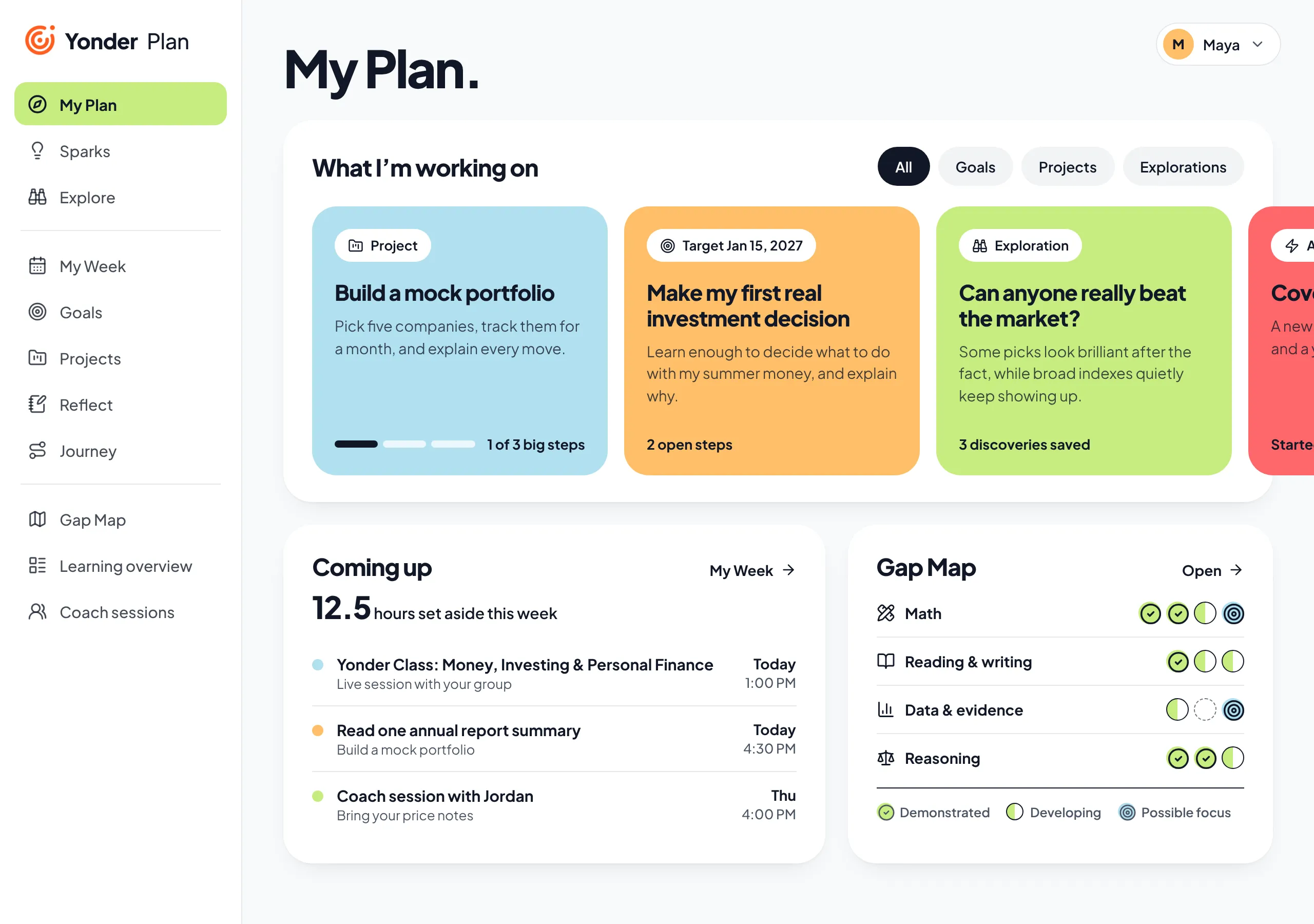
The home base
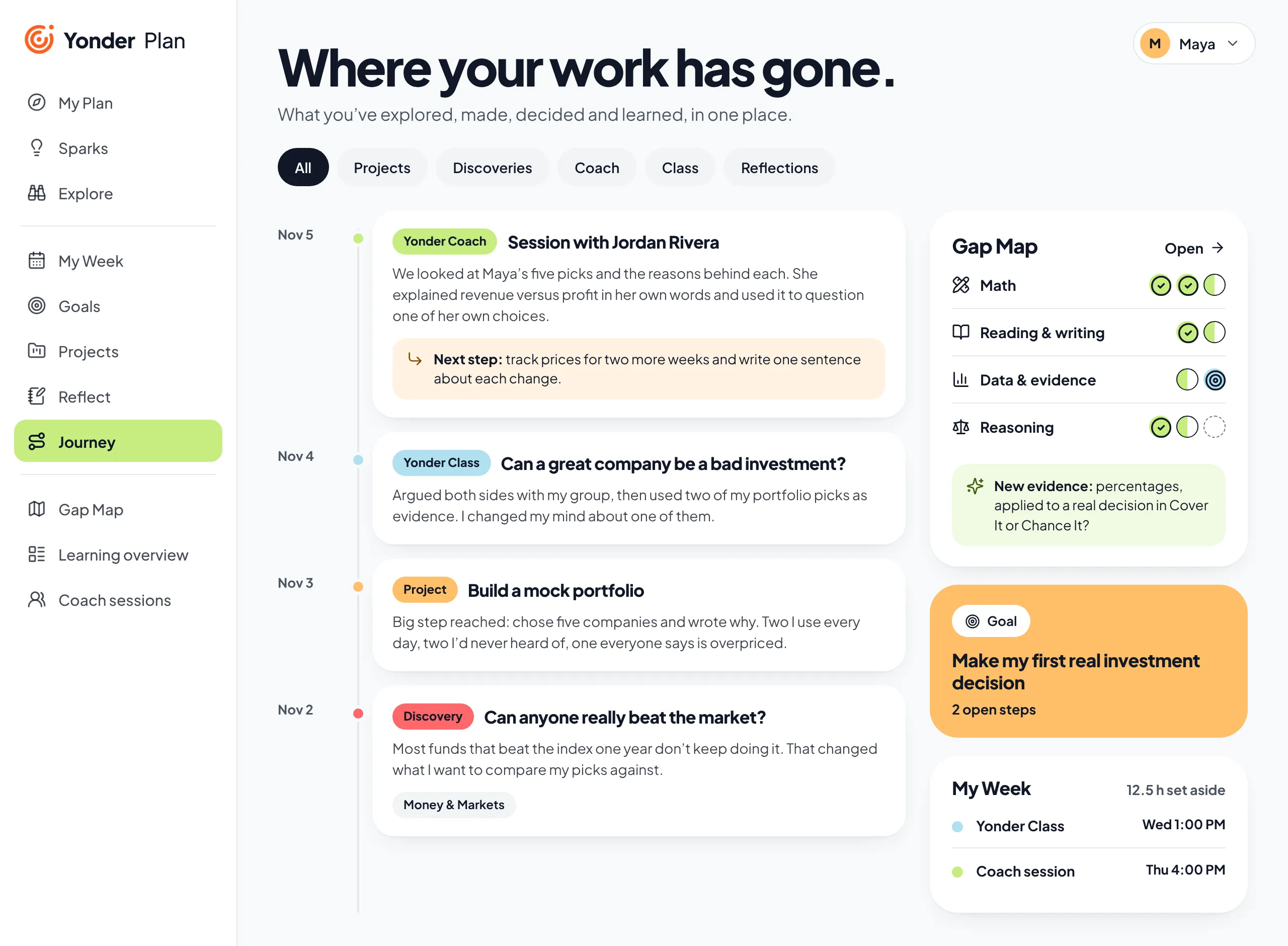
A digital workspace for Sparks, Projects, My Week, and the growing Journey of what your teen has explored, tried, and accomplished.
Explore Yonder PlanWe connect engaging learning experiences with meaningful instruction that helps teenagers build essential knowledge, tackle real problems, and discover what they're capable of.
 Yonder CoachOne-to-one guidance
 Yonder ClassLive group exploration
Your teen finds something worth pursuing. We find out what they already know, teach what’s missing, and help them put it to work. Every step adds to a clearer picture of how they’re growing.
More chances to discover what matters to them.
Learning that responds to your teen instead of treating everyone the same.
Help where it’s needed, with real chances to show progress.
Greater capability, ownership and direction.
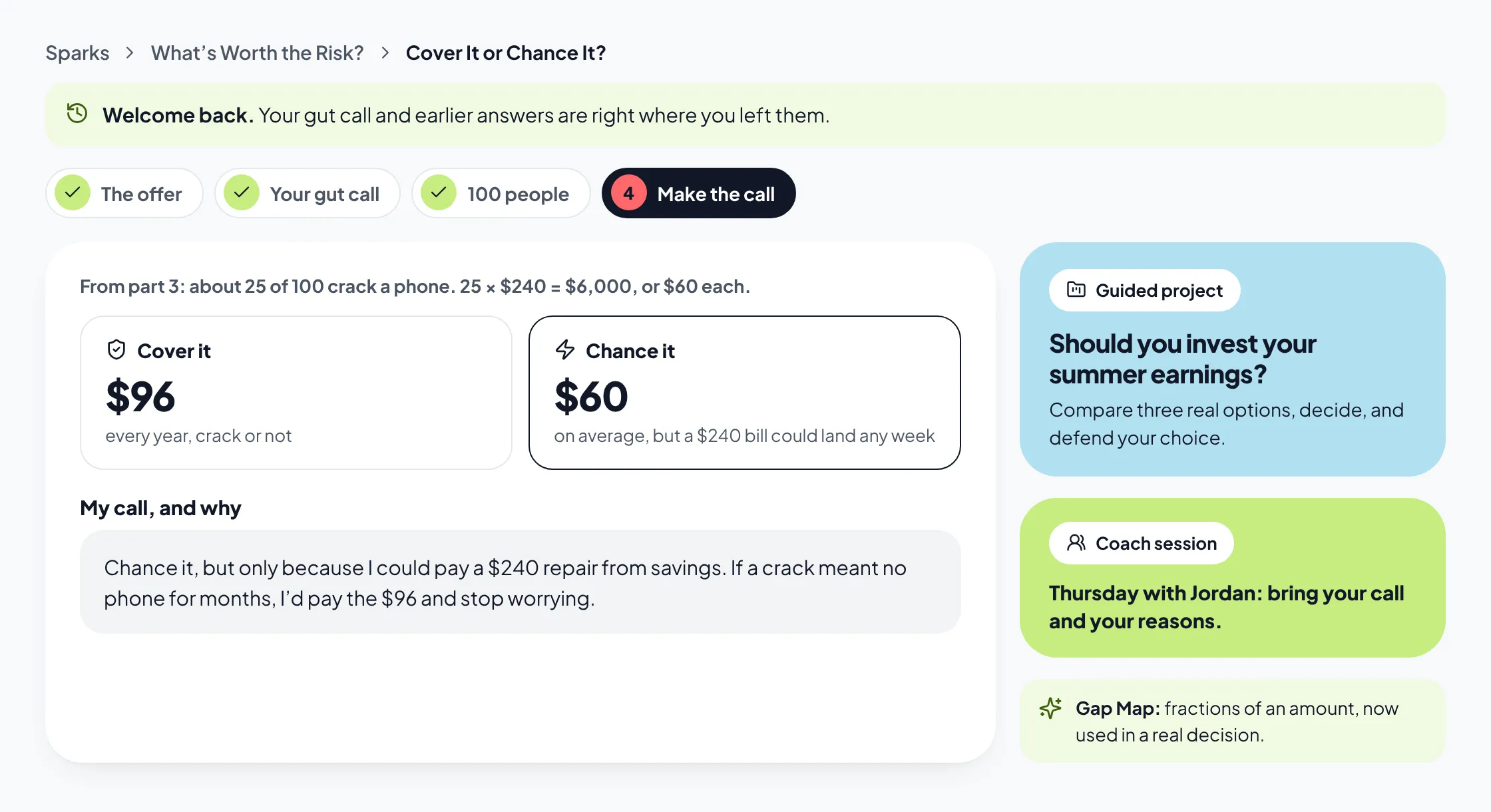
We invite teens into Sparks: worthwhile questions, decisions and challenges in areas like money and markets, engines, game design and health. They can explore an idea, try a hands-on activity, take on a guided project, or turn an interest of their own into a project.
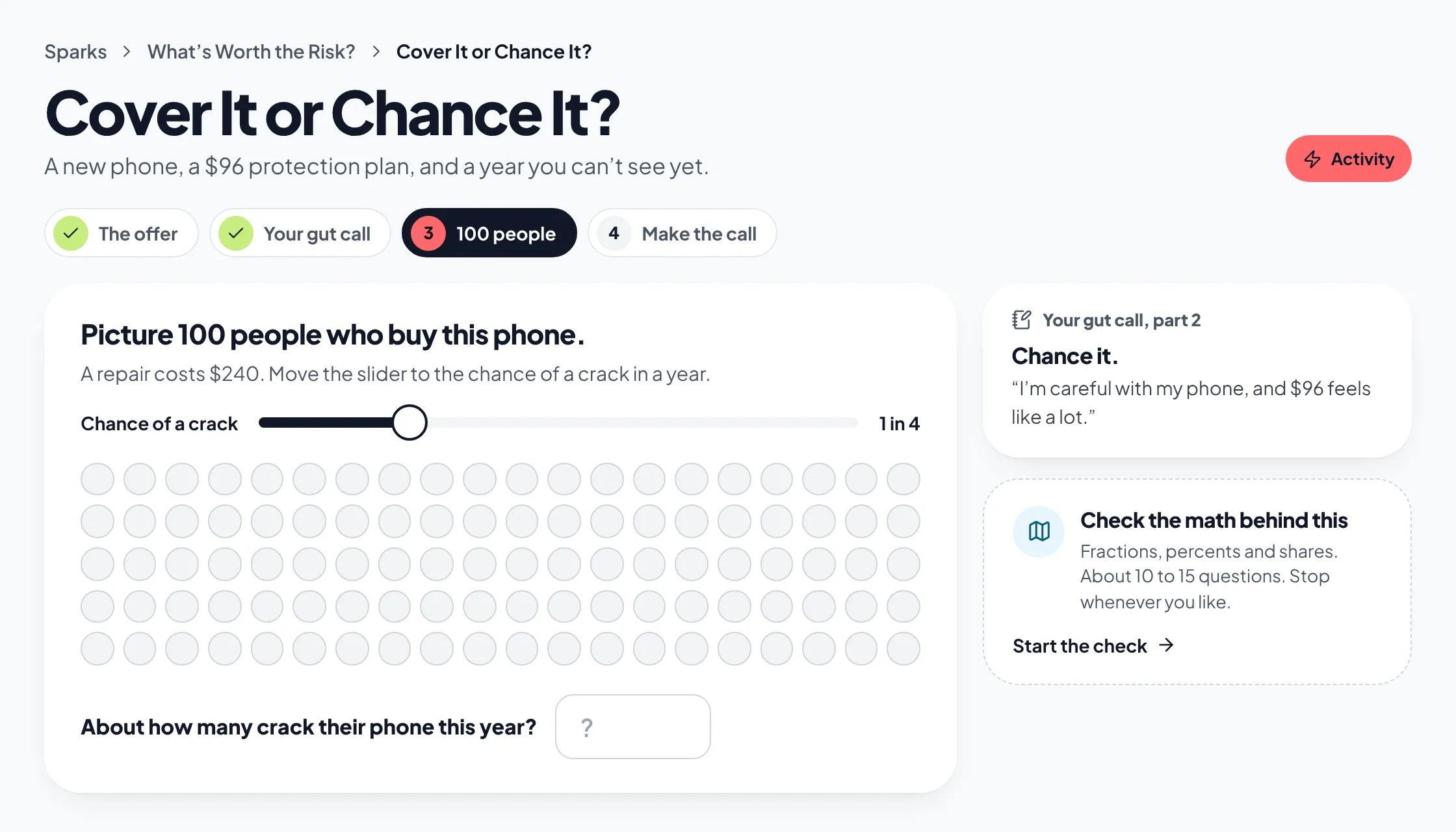
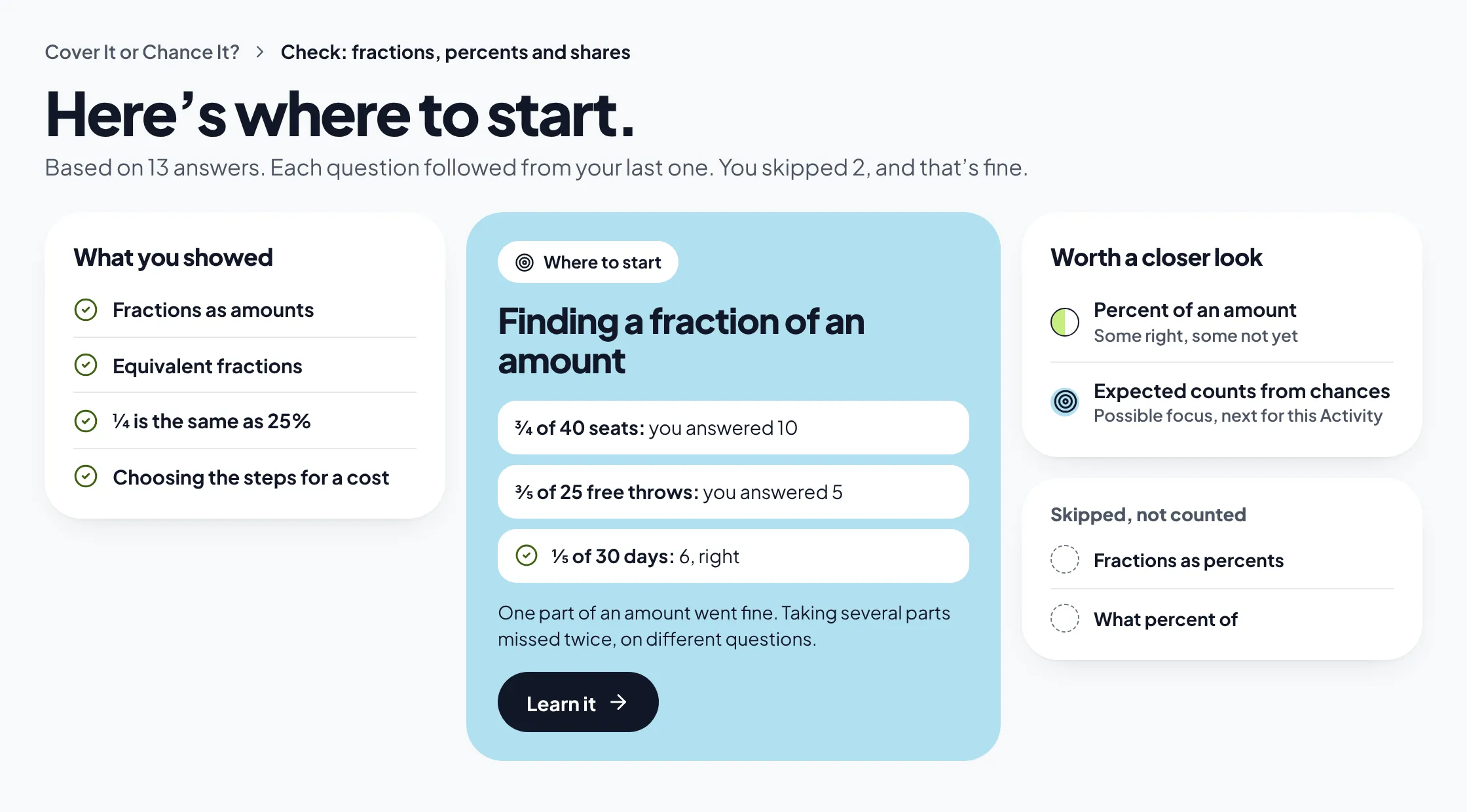
When the work calls for a skill, a short check finds out what your teen already understands. Each question follows from their last answer, and they can skip anything they’re unsure of. We look for a pattern across several questions before suggesting where to start, never a single slip.
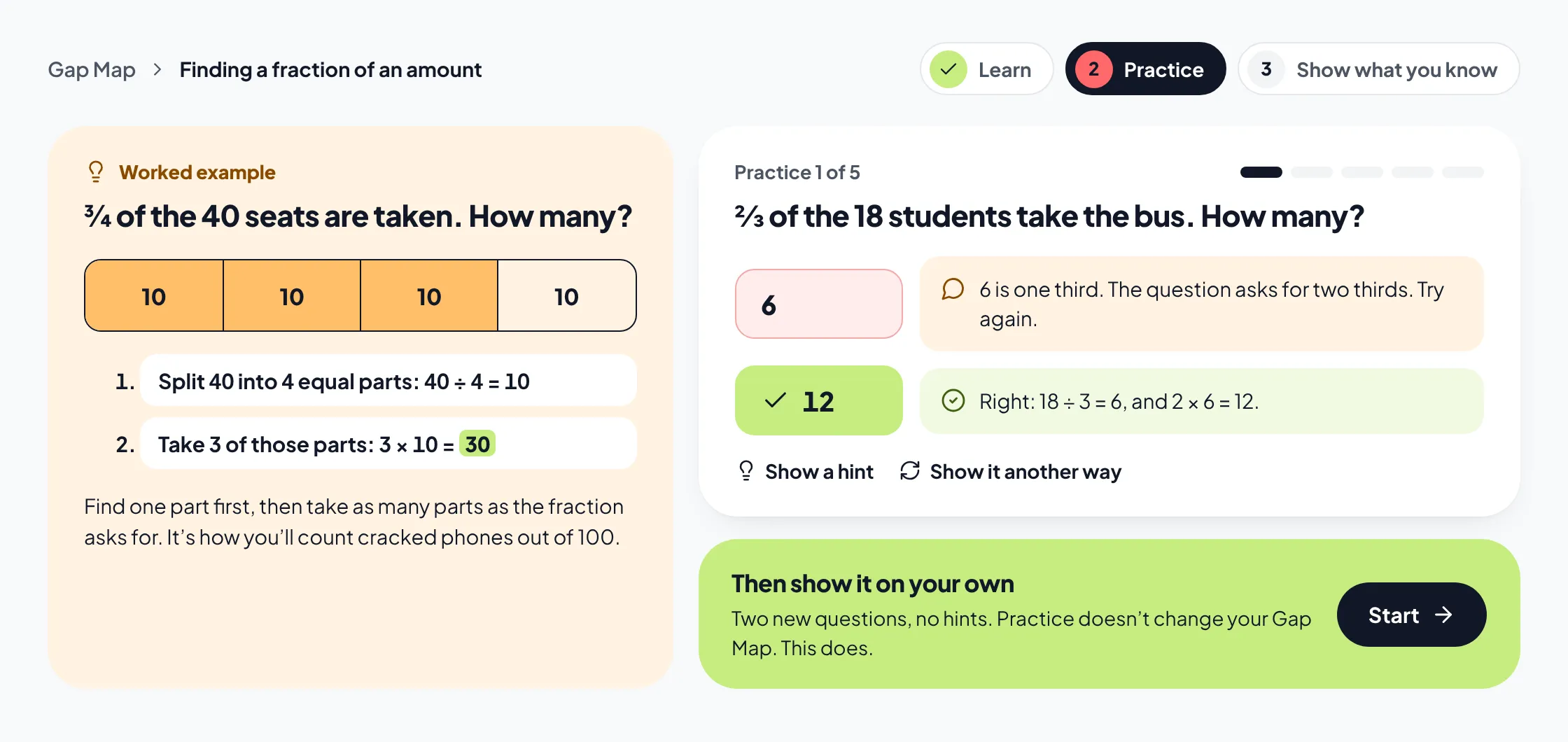
We teach the specific idea that’s missing, with a clear explanation and a worked example tied to the question they’re trying to answer. Practice gives feedback after every answer and another try when they need it. If they keep getting stuck, we show it a different way or step back to an earlier idea. When they’re ready, a few fresh questions without hints show what they can now do on their own.
Then they return to the challenge that started it, with their earlier work saved, and use what they learned to make a real decision or move a project forward. The next challenge builds on it, and a Coach or Class can push their thinking further.
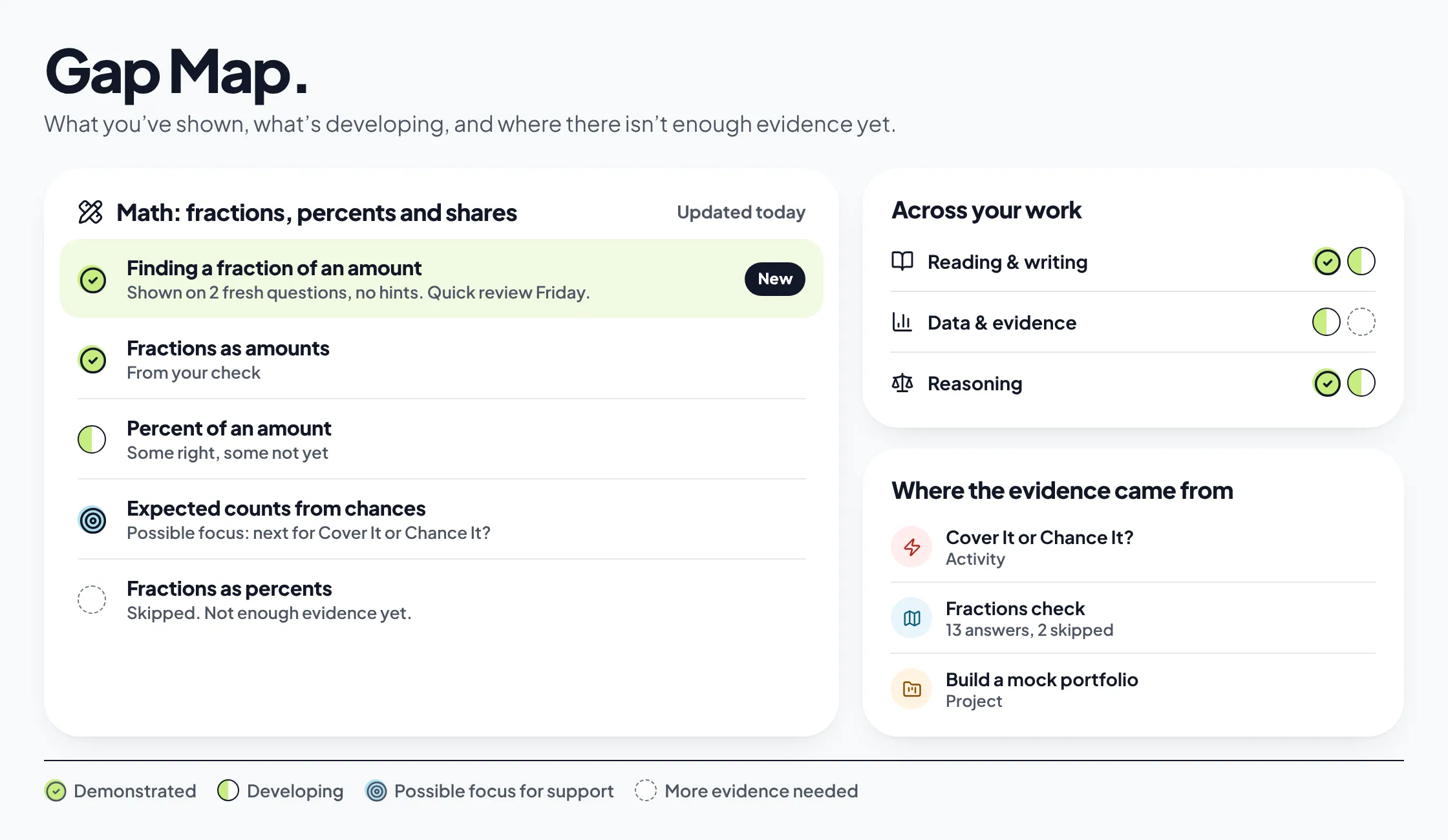
Every check and every piece of real work updates the Gap Map, a picture of what your teen has demonstrated, what’s still developing and where we need more evidence. Learning doesn’t have to start over with every new experience.
Whether they're investigating a question or working on a project, teenagers can develop abilities that become useful well beyond the subject they're exploring.
What do I know, and how does this work?
Why does a turbocharger add power? How does a stock get its price? They get the real explanation, with help and practice when they need it.
What can I do with it?
They use it: test an idea, build something, or work out a recommendation, with real tools and AI, and see whether it holds up.
What should I do?
They weigh trade-offs, make decisions without one obvious answer, and adjust when the results surprise them.
What is worth pursuing, and why?
After trying enough different things, they know more about what deserves their time and what they are good at, and own more of where they are headed.
Use Yonder Plan on its own, or combine it with the kind of human support that helps your teen go even further.
Explore by yourself.
The home base
A digital workspace for Sparks, Projects, My Week, and the growing Journey of what your teen has explored, tried, and accomplished.
Explore Yonder PlanGo further with a guide.
One-to-one guidance
A trained education professional who gets to know your teen, challenges their thinking, helps them past roadblocks, and checks in on what they tried.
Explore Yonder CoachThink bigger with a group.
Live group exploration
Six-week online classes with an instructor who explains the ideas, plus discussion, projects, peer feedback, and work students can explain and defend.
Explore Yonder ClassIn Yonder Plan, we connect guided experiences, independent projects, and an evolving picture of foundational learning. Every Coach membership and Class enrollment includes Plan, so guidance and group learning can build on the same understanding of what each student is exploring and learning.
Find something worth exploring.
Turn an idea into something real.
Make time to keep it moving.
Keep a record of what they’ve explored, tried, and accomplished.
See how foundational skills can grow across experiences.
Adds one-to-one Socratic guidance, thoughtful challenge, direction, and follow-through, informed by the student's learning.
Adds shared inquiry, Socratic dialogue, peer critique, and collaboration, with learning insights guiding meaningful challenges.
Your teen keeps meaningful ownership of what they pursue. We give them structure, useful tools, thoughtful adults, and other students who can help them go further without choosing the path for them.
Your teen can use AI the way capable adults increasingly do. What stays with them is the part that develops them: deciding what the work is for, what to hand off, and when to push back.
Research faster, build and test ideas, analyze data, and produce polished materials they could not make alone.
Set the goal, what good looks like, the limits that matter, and which parts to hand to AI.
Question the approach, redirect it, try alternatives, and notice when a polished answer does not serve what they are actually trying to do.
You should understand what your teen is exploring, what they’re working on, and where they may need support without having to manage the experience for them.
See the interests, Sparks, projects, classes, and topics taking shape.
Understand the projects, next steps, class work, and other things they’re spending time on.
Have enough context to ask useful questions and encourage them while leaving the decisions and ownership with your teen.

Explore by yourself.
Best when: They’re ready to explore independently and want a place to organize what they’re pursuing.
Go further with a guide.
Best when: They’d benefit from a consistent adult who can ask questions, help them make decisions, and keep things moving.
Think bigger with a group.
Best when: They want to explore a topic through discussion, projects, problems, and other students’ perspectives.
Not sure where to start?
Book an Intro CallA clear way to understand the system, the options, and where to begin.
We give teenagers new things to explore, meaningful work to take on, and a say in what they pursue next, through Yonder Plan, Yonder Coach, and Yonder Class.
Yonder Plan is the shared digital workspace. Coach adds one-to-one guidance. Class adds live group exploration. Families can use Plan independently or combine it with Coach or Class when that support helps.
No. Your teen can start with a Spark, a skill on their Gap Map, or a project of their own. If they already know what a challenge calls for, they go straight to the work. If they don’t, we teach it first. The four steps describe how the parts connect, not a fixed route.
No. It’s a working picture built from what your teen does in Yonder: checks, Sparks and projects. It shows what they’ve demonstrated, what’s still developing, and where there isn’t enough evidence yet. It isn’t a grade, a standardized score, or the result of a supervised exam.
Yes. Yonder Plan is a standalone digital workspace and can be used independently for $39 per month.
Yes. Yonder Plan is included with every Yonder Coach membership and Yonder Class enrollment.
Start with the kind of support that fits right now. Plan works well for independent exploration, Coach adds consistent one-to-one guidance, and Class adds live discussion and peer learning. If you’re unsure, Start with Yonder helps you choose.
Yes. Your teen does not have to choose one permanent path. You can add a different kind of support as their interests and needs change.
No. We aren’t a service for completing school assignments or preparing for tests, therapy, or admissions strategies. Guided experiences provide instruction and practice when new knowledge or skills are needed, connected to meaningful work students choose to pursue.
Give your teen a place to pursue what they care about, take on real challenges, and become more capable of directing their own path.