New possibilities to discover. The skills to pursue them.

We give your teen new ideas to explore and a place to pursue their own. Through guided experiences, they can learn something new, try it out, and build skills for what they want to do next.

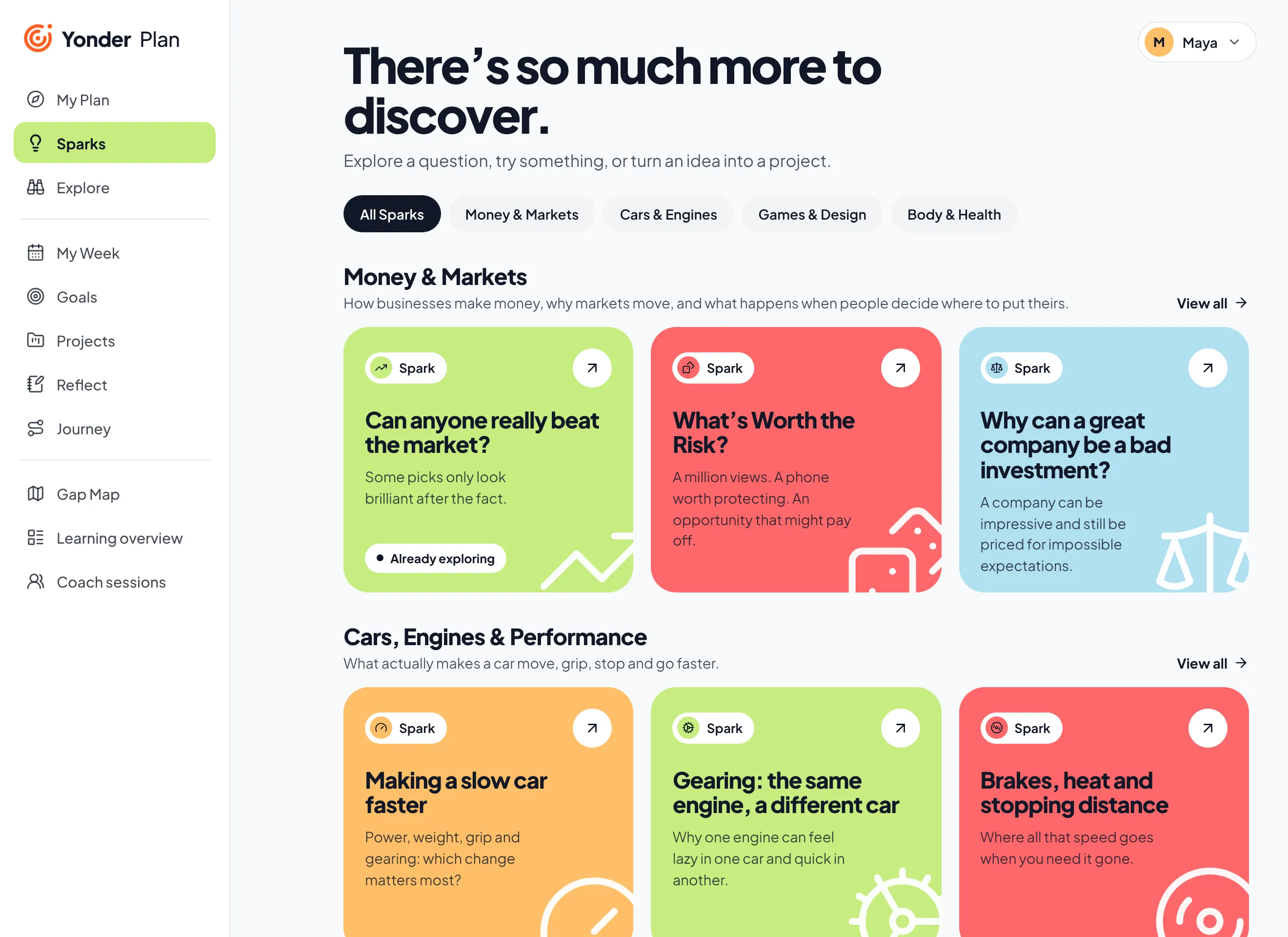
Yonder Plan Sparks page: Spark cards in Money and Markets and in Cars, Engines and Performance, one marked already exploring
Teenager smiling with a notebook and backpack

Two ways teenagers use Yonder Plan.

We help teenagers explore worthwhile possibilities and build foundational skills through Sparks and the Gap Map. We also give them a workspace to plan, pursue, and reflect on self-directed projects.

Explore new interests. Build skills that matter.

We introduce teenagers to subjects worth exploring through Sparks and guided experiences. When a challenge reveals a gap in math, literacy, data, or reasoning, we help them strengthen that skill and connect the learning through the Gap Map.

  • Start with a Spark

    Discover a worthwhile question or topic.

  • Get focused support

    Build the skills the work requires.

  • See learning connect

    Use the Gap Map to recognize demonstrated strengths, developing skills, and areas needing attention.

See how Sparks and the Gap Map work
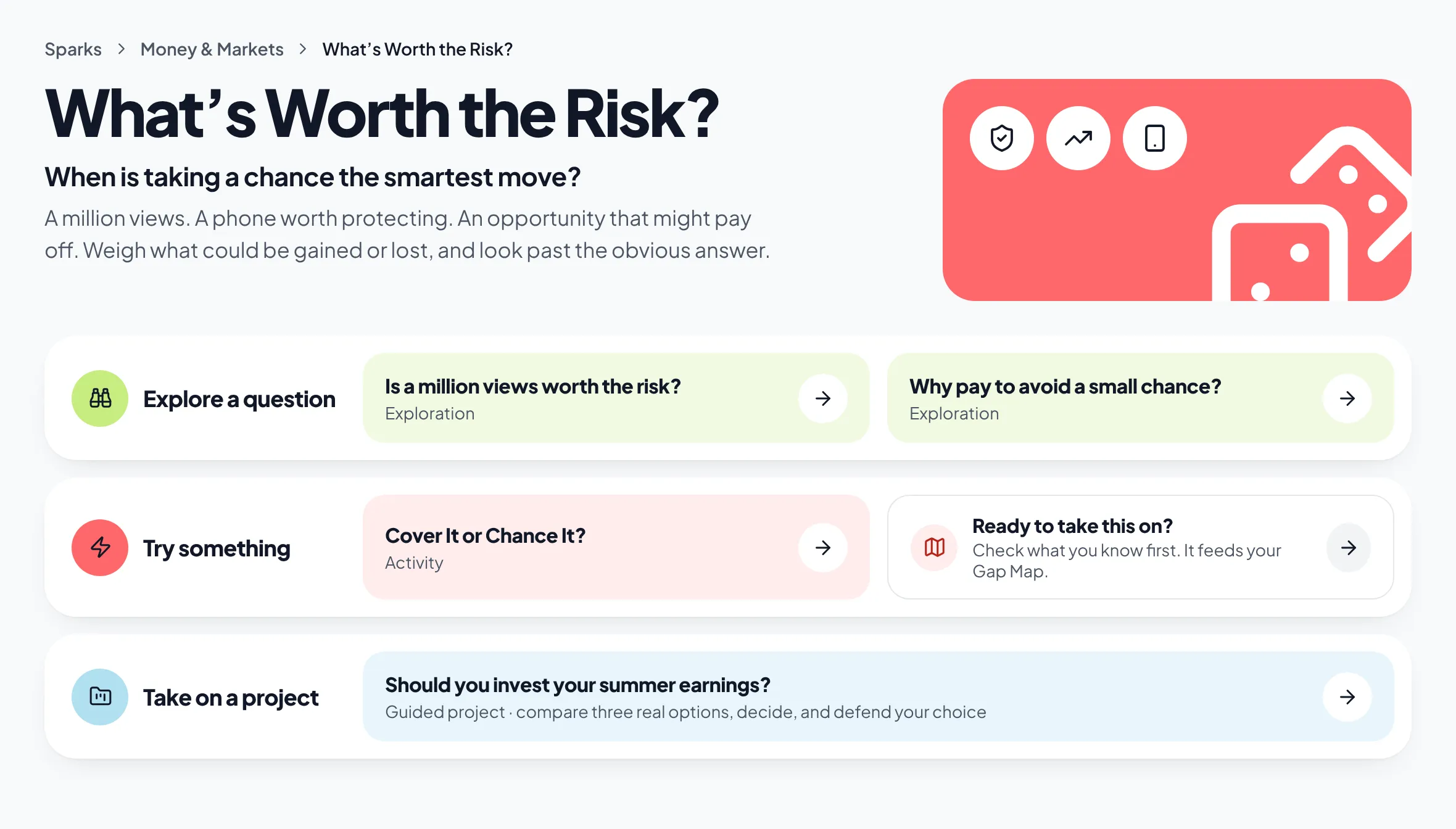
The Spark What’s Worth the Risk? with three ways in: explore a question, try the Activity Cover It or Chance It? with a readiness check that feeds the Gap Map, or take on a guided project

The Gap Map

  • Mathematical literacy
  • Reading and communication
  • Data and evidence
  • Applied reasoning
  • Demonstrated
  • Developing
  • Possible gap

Plan your own work. Carry it through.

We give teenagers a personal workspace to organize goals, plan next steps, manage their week, and pursue self-directed projects. They can take ownership of meaningful work while developing independence, organization, and follow-through.

  • Choose what to pursue

    Turn an interest, question, or personal goal into a project.

  • Plan and follow through

    Use Goals, My Week, and other workspace tools to organize the work.

  • Reflect and show the work

    Bring decisions, progress, reflections, and accomplishments together in Journey.

See how the workspace works
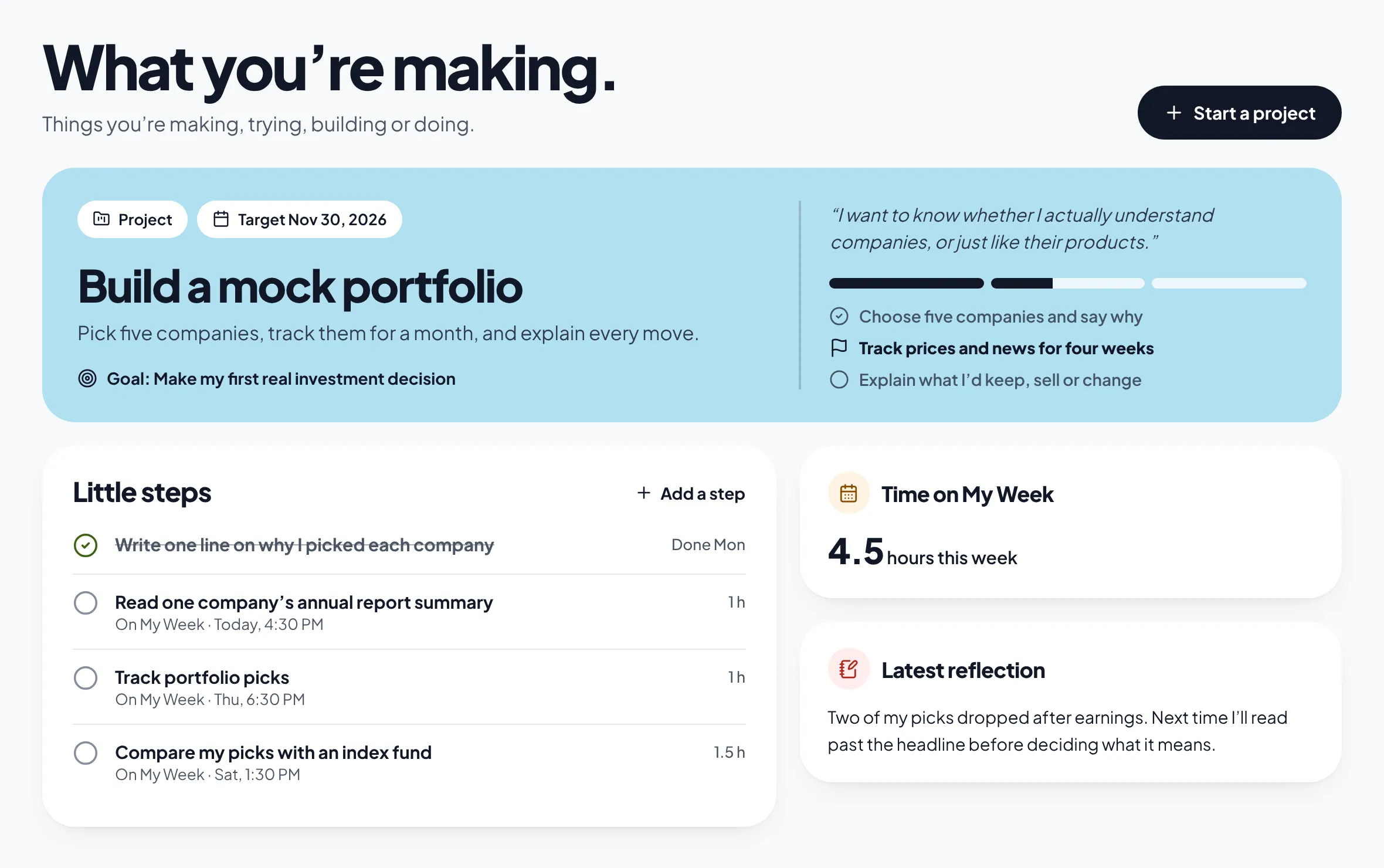
Projects page: the project Build a mock portfolio, tied to the goal of making a first real investment decision, with its big steps, little steps scheduled on My Week, time set aside and the latest reflection

Every Spark is a question worth exploring. Your teen chooses how deep to go.

Follow a question, try a focused experience, or settle into a bigger pursuit. These are parallel choices, with different amounts of time and depth. Your teen can start with any one.

Explore a question

Exploration

Follow their curiosity.

Discover new subjects, investigate interesting questions, and choose where to go next.

Time commitment
Open-ended. They decide how far to explore.
Learning depth
Build understanding without a required outcome.

Try something

Activity

Learn by doing.

Try a focused, interactive experience. Experiment, make decisions, and discover something firsthand.

Time commitment
Short and focused.
Learning depth
Put an idea into action and see what happens.

Take on a guided project

Curated project

Take on something bigger.

Go deeper with teaching, guided investigation, meaningful decisions, feedback, and room to improve.

Time commitment
A deeper pursuit across multiple sessions.
Learning depth
Build and apply skills through substantial work.

Discover what they know. Build what they’re missing.

Your teen spends their time on what they actually need. We find out what they already understand, teach what’s missing, and check that it holds up on new work. Everything they show adds to one connected picture: the Gap Map.

  1. Spark or skill
  2. Discover
  3. Learn
  4. Practice
  5. Check
  6. Gap Map
  7. Back to the work

They can start from a Spark or from a skill they want to strengthen.

Discover what they already know.

A few focused questions show what your teen already understands, what’s still uncertain, and which underlying skill may need attention. The payoff: they don’t redo what they’ve already shown just to get help with one narrower gap.

  • Questions are set in real situations, not drills.
  • No timer and no grade. They can skip a question or pause.
  • Results show what was right, what wasn’t quite, and a useful next step.
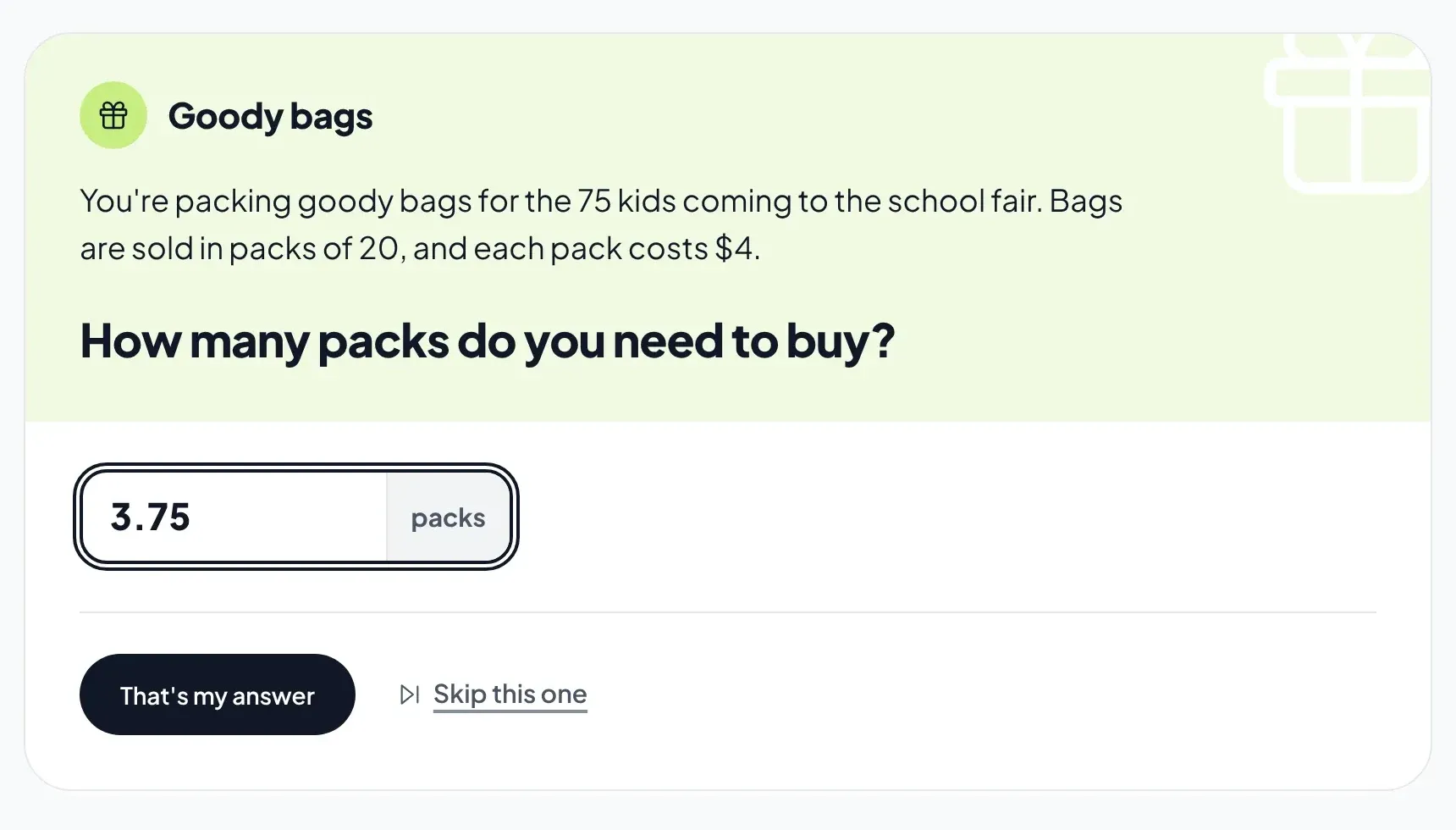
A Discover question in Yonder Plan: packing goody bags for 75 kids when bags come in packs of 20, asking how many packs to buy, with a Skip this one option beside the answer button
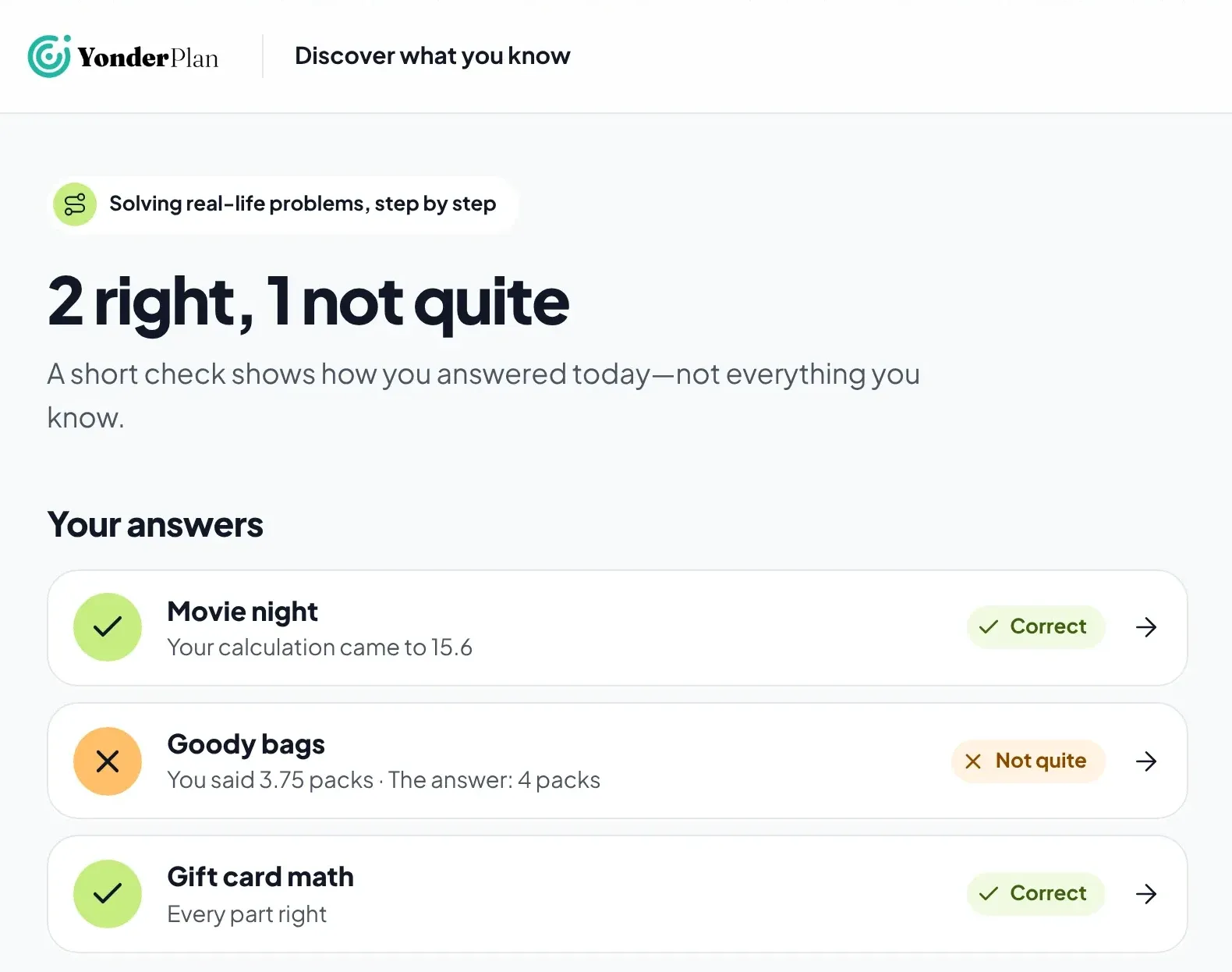
Discover results: 2 right, 1 not quite, with the note that a short check shows how you answered today, not everything you know, and each answer marked Correct or Not quite

Build what they need.

When a skill stands in the way, we teach that specific concept rather than a whole unit, then help them practice until it clicks. It’s real teaching built around the skill in front of them, not a worksheet handed out after a quiz.

Targeted instruction
Teaching aimed at the one concept they need.
Worked examples
Clear explanations that show each step and why it works.
Guided practice
Hints when they want them, and feedback that explains each answer.
Adjusts as they go
Practice follows their answers, stepping back to a missing idea or moving ahead.
A way back
Once it comes together, they return to the Spark or goal that brought them here.
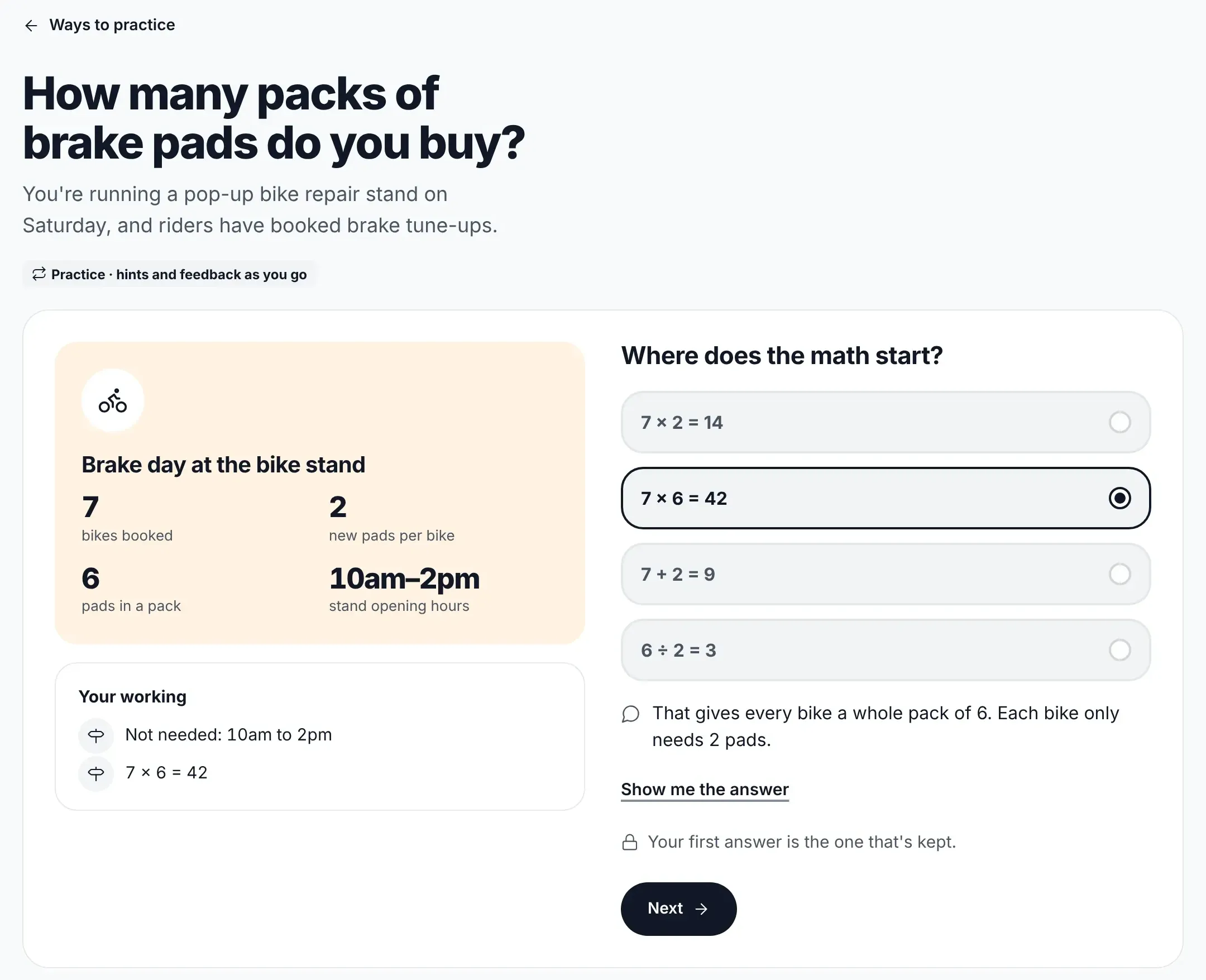
Practice in Yonder Plan with hints and feedback as you go: a bike-stand problem about brake pads, the student’s working so far, a chosen answer and feedback explaining that each bike only needs 2 pads, with a Show me the answer option
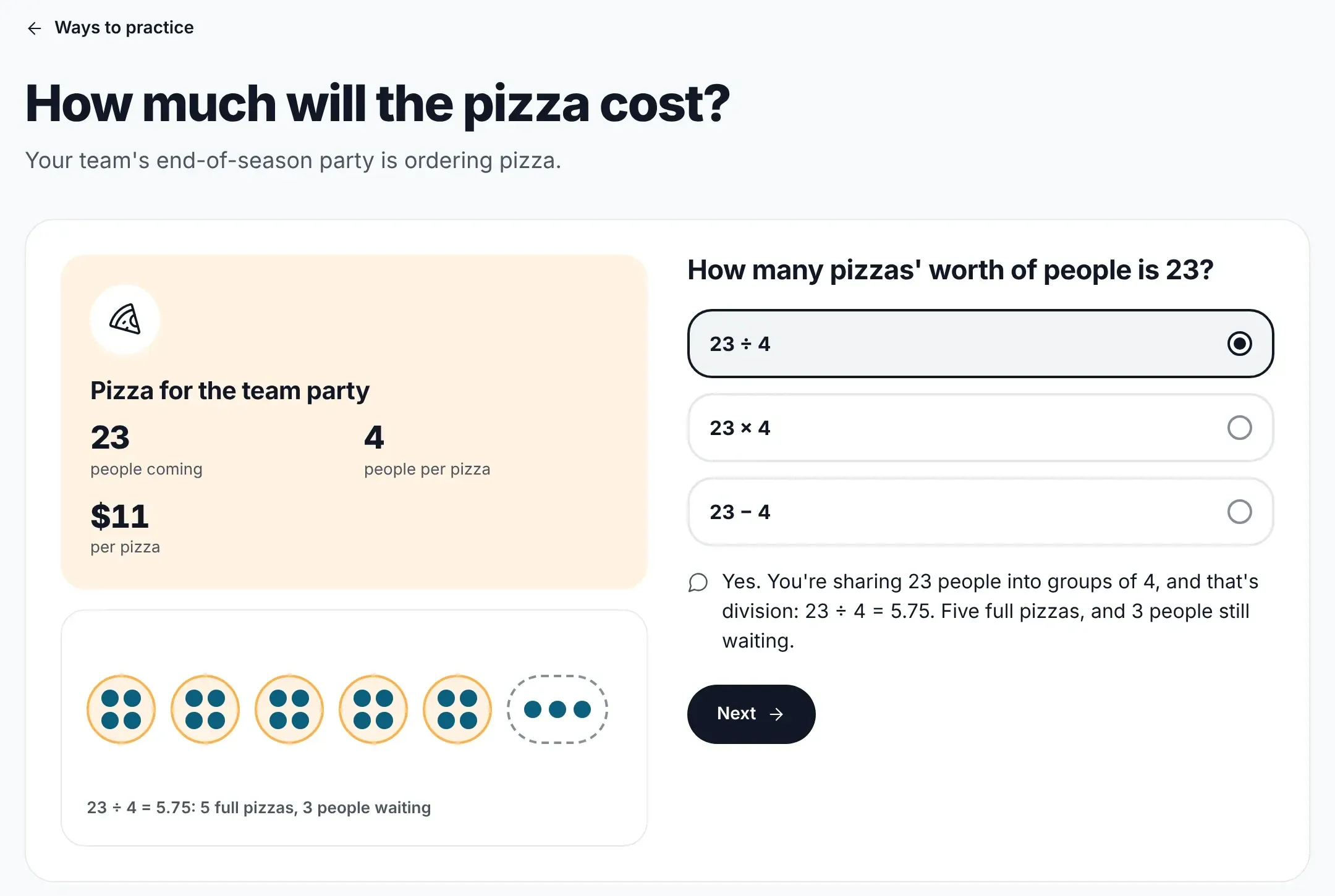
A worked example in math practice from Cover It or Chance It?: 23 people shared into pizzas of 4, drawn as groups, with an explanation of why the step is 23 divided by 4

See what they’ve learned.

Practice is where they learn with help. A check is where they show it: fresh questions in new situations, with no hints. Finished practice or one right answer isn’t treated as mastery.

The Gap Map brings that evidence together across every Spark and skill, so you and your teen can see where they’re strong, what’s still developing, and where support may help.

  • Shown on their own. Right on fresh questions, without help.
  • Developing. Coming together, or done with help so far.
  • Possible gap. Missed across different questions. Worth focused support.
  • Not enough evidence yet. Not tried, skipped, or too little to tell.
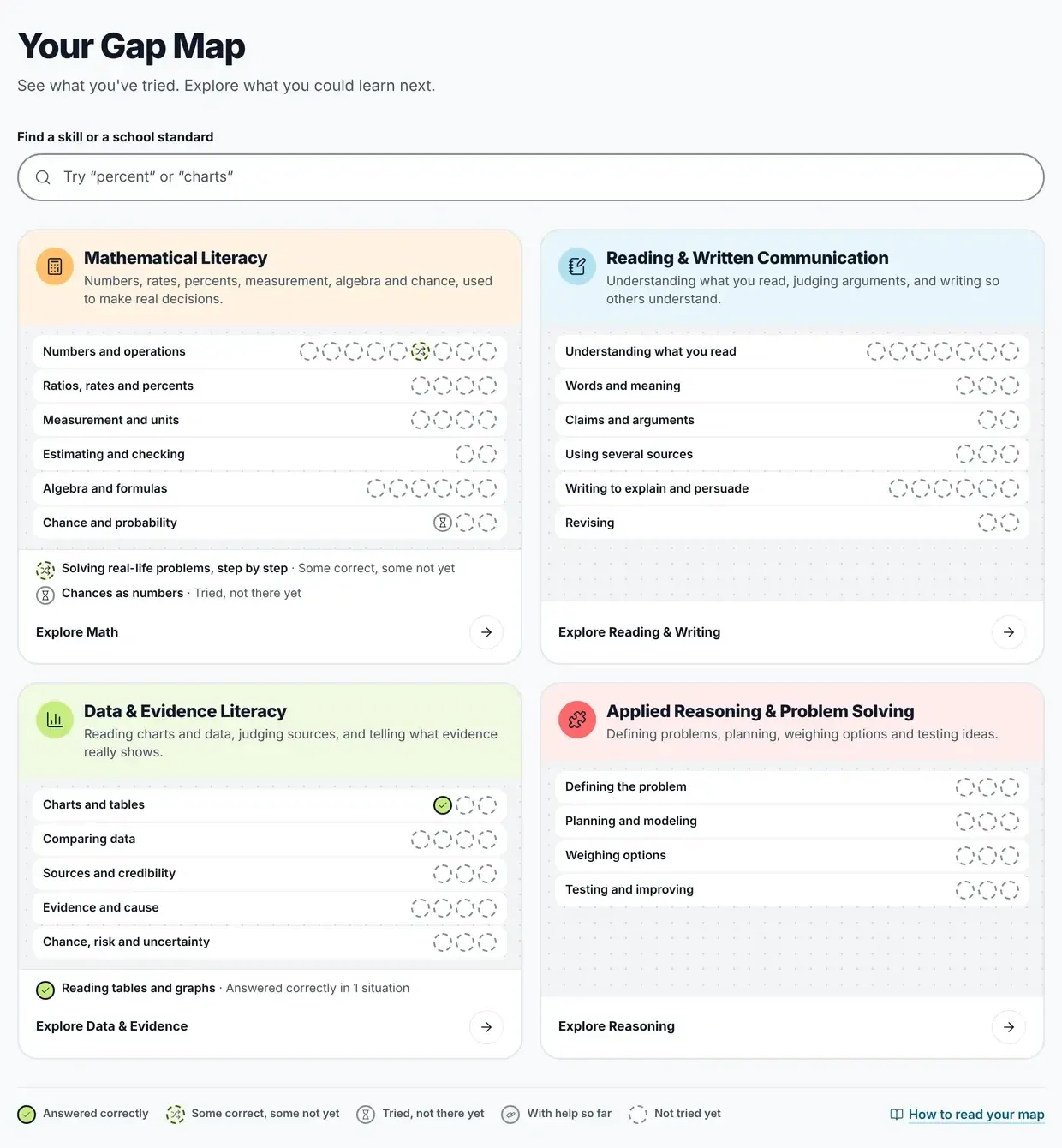
The Gap Map in Yonder Plan: four foundational skill families, Mathematical Literacy, Reading and Written Communication, Data and Evidence Literacy, and Applied Reasoning and Problem Solving, each listing its skills with evidence markers and a key
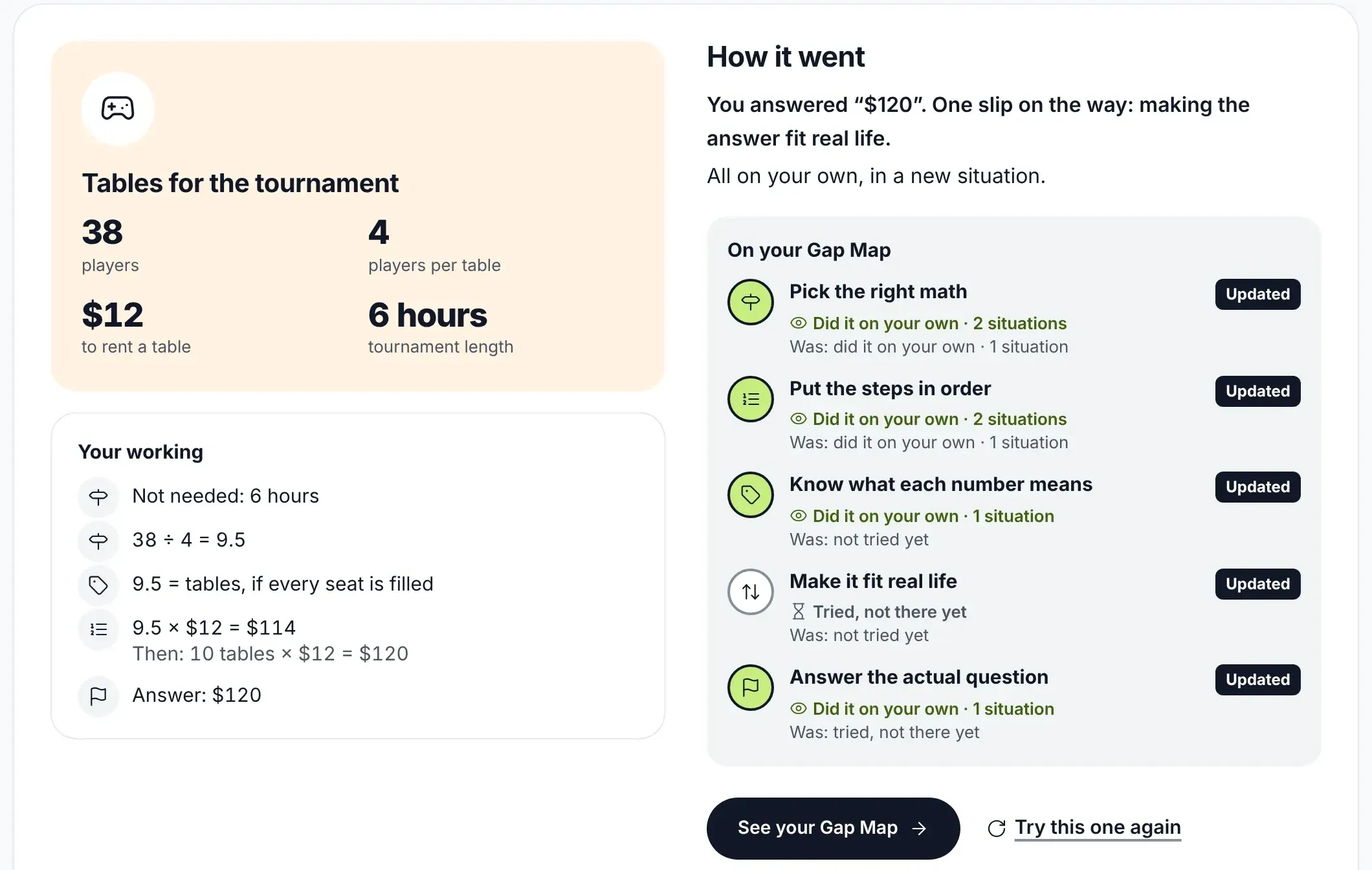
A check result: answered all on their own in a new situation, with one slip on making the answer fit real life, and five skills marked Updated on the Gap Map

Put learning to work.

Skills matter most when they’re used. With a stronger foundation, your teen goes back to the Spark, challenge or project that sent them looking, ready to do more with it. From there, the Gap Map helps point the way to:

  • Foundational support where a skill still needs work
  • Review that keeps what they’ve learned fresh
  • Sparks and projects where a skill they’re building matters
  • Yonder Coach guidance grounded in what they’ve shown
  • Yonder Class learning that builds on what they bring
The Spark What’s Worth the Risk?: explore a question, try the Activity Cover It or Chance It? with a readiness check that feeds the Gap Map, or take on a guided project

Take ownership of their direction.

Student-directed projects start with your teen: an interest, a question, or a goal they decide to pursue. They set the direction. Goals, Projects, My Week and Journey help them organize the work, follow through, and see how far they’ve come.

Curated projects
Guided experiences we design inside a Spark, with the teaching, feedback, and room to improve built in.
Student-directed projects
Pursuits your teen chooses and manages, using the workspace to plan the work, make time for it, and reflect.

Everything they’re pursuing, in one place.

Goals with target dates, projects broken into steps, and the Explorations they’re following sit together on My Plan, beside the Gap Map. When their own project calls for a skill they want to strengthen, the same checks and practice are there, and they get straight back to the work.

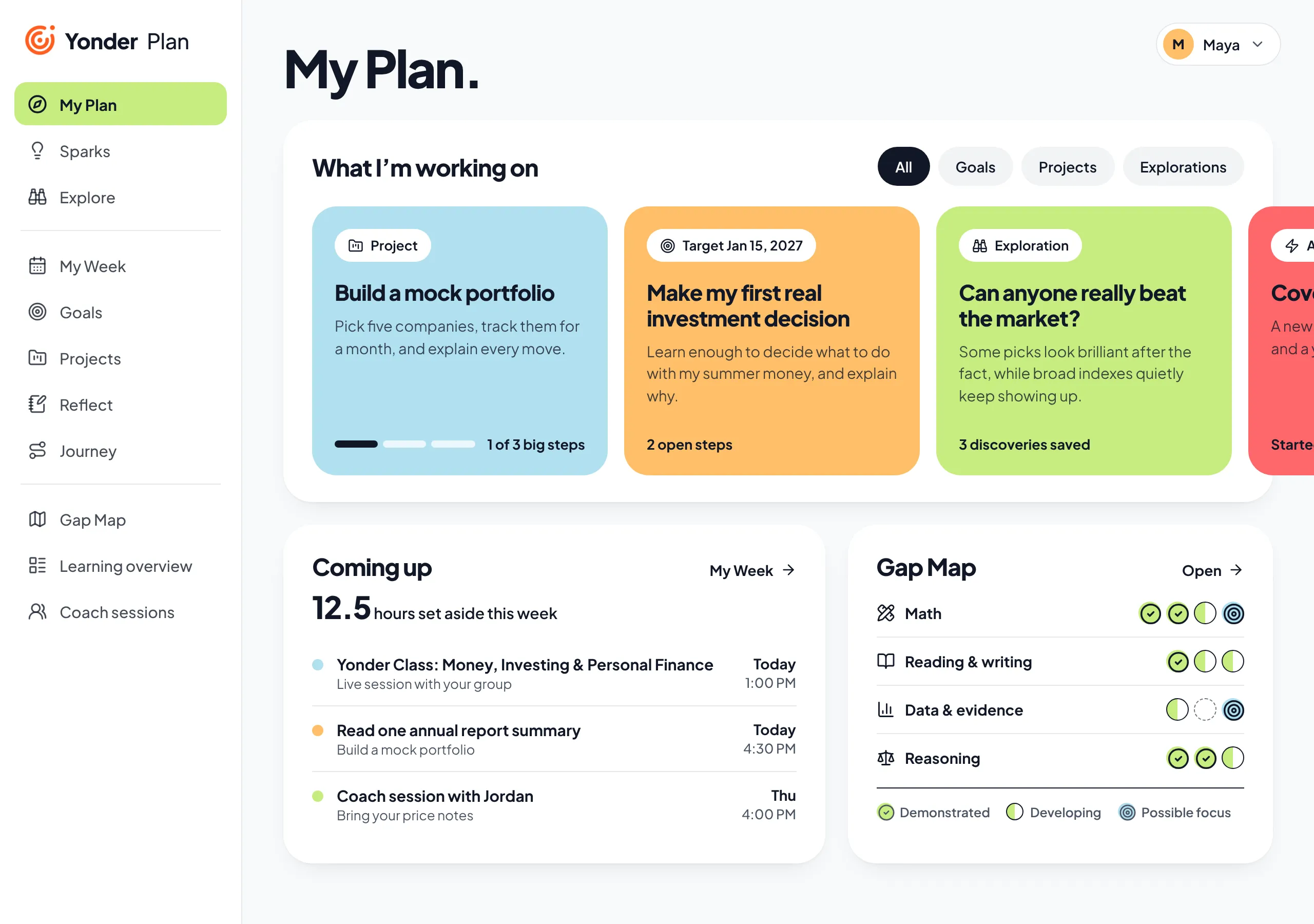
My Plan: what the student is working on, including a project, a goal with a target date and an Exploration, beside the hours set aside this week and a Gap Map summary across math, reading and writing, data and evidence, and reasoning
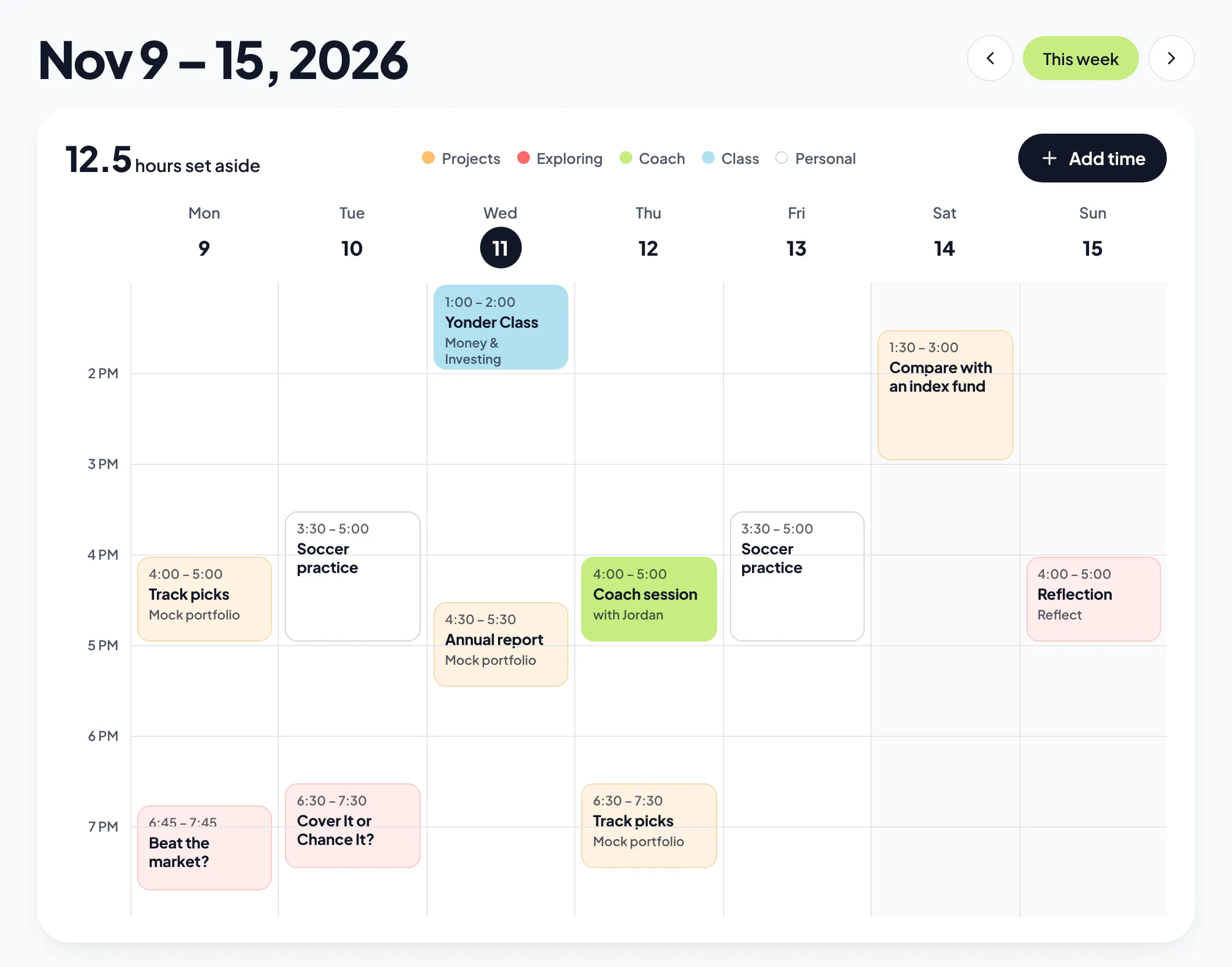
My Week for November 9 to 15: time set aside for portfolio work, an Exploration and an Activity, a Yonder Class session, a Coach session, soccer practice and a weekly reflection
  • Goals

    Set clear goals for what they want to learn, make, or accomplish.

  • Projects

    Turn their ideas into projects, organize the work into Little Steps, and keep moving forward.

  • My Week

    Make time for what matters, plan next steps, and adjust when life changes.

  • Reflections

    Capture what worked, what they learned, and what they want to do differently.

Show what they’ve learned and accomplished.

Journey is where the work adds up: a record of the questions they followed, the projects they started, and what they learned along the way.

  • Bring their work togetherKeep what they explored, attempted, and created in one place, with work samples and reflections.
  • Make accomplishments visibleSee the decisions they made, how the work changed, and what they accomplished.
  • Show how they’ve grownLook back at the interests and capabilities they’ve developed over time.
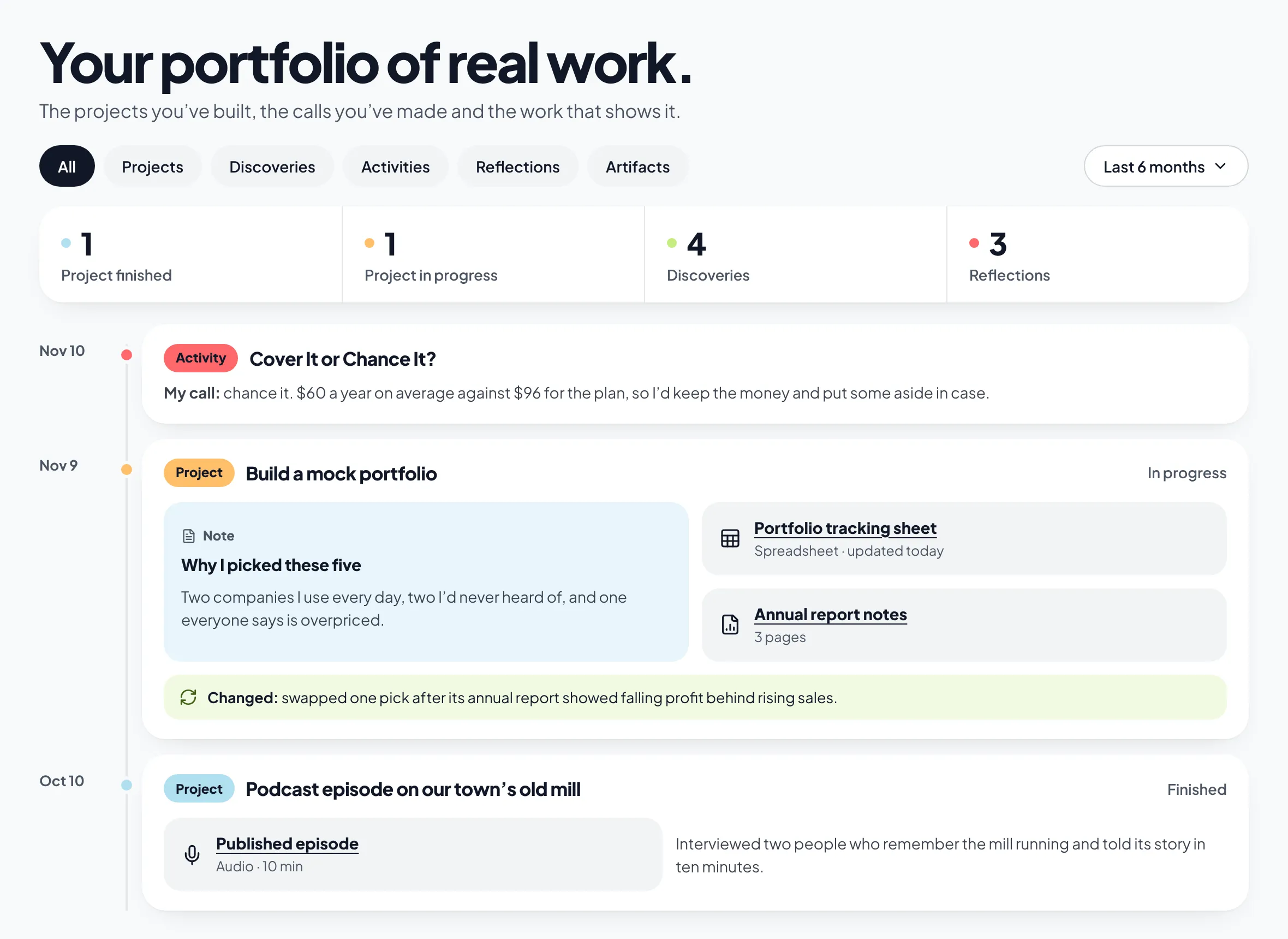
Journey timeline: the decision made in the Activity Cover It or Chance It?, the mock portfolio project in progress with a written note, a tracking sheet, annual report notes and a changed pick, and a finished podcast episode project

Discover more. Build real skills.

We bring guided Sparks, focused foundational instruction, self-directed projects, and the Gap Map together in one subscription. Your teen can pursue what interests them, strengthen skills they haven't mastered, and put what they learn to work in the next challenge.

  • Explore guided Sparks, activities, and projects
  • Strengthen missing skills through focused instruction
  • Use the Gap Map to see strengths and learning needs
  • Pursue personal projects with goals, My Week, and Journey

Yonder Plan is included with any Yonder Coach membership or Yonder Class enrollment.

Want to try Yonder Plan for free?

Start with two free Sparks filled with surprising questions, meaningful challenges, and opportunities to learn by doing. No credit card. No deadline. Just something worthwhile to explore.

Free Explorer Sparks

What’s Worth the Risk?

Free Explorer

When is taking a chance the smartest move?

A million views. A phone worth protecting. An opportunity that might pay off.

What’s worth the time, money, or chance of losing out? Your teen investigates real-world financial decisions, weighs what could be gained or lost, and looks beyond the obvious answer. Sometimes the smartest choice is to take the risk.

Explore how to make better financial decisions when the outcome isn’t guaranteed.

Fit for What?

Free Explorer

What does getting stronger mean when you’re still growing?

Growing taller. Getting stronger. Two changes that don’t always happen together.

Why do some teenagers get stronger faster than others? Can strength change before size does? Your teen explores the science of growth and human performance, investigates how growing bodies adapt, and questions familiar fitness assumptions.

Discover what a growing body can do, and why there isn’t one definition of fit.

A real place to start.
Room to come back.

Free Explorer includes two curated Sparks and complete guided work within their free experiences. Your teen can work on one free project at a time, with saved work to pick up when they return.

No payment requirement. No trial expiration.

Want to go further? The full Yonder Plan subscription adds the wider Spark library and a personal workspace, including Goals, My Week, Journey, and Build My Own.

See the full Yonder Plan

The best way to understand Yonder is to experience it.

Let your teen choose something that interests them, discover something new, and see where their curiosity takes them.

Free forever. No credit card required.

Questions about Yonder Plan

What they can explore, how the learning works, and what’s included.

What is Yonder Plan?

We bring together a growing library of worthwhile learning experiences and a workspace to keep meaningful pursuits going. Your teen can discover unfamiliar subjects, follow questions, try hands-on Activities, and take on guided projects. When an idea becomes something they want to pursue themselves, Goals, Projects, Reflections, My Week, and Journey help them make it their own. It’s one subscription at $39 per month.

What can my teenager do with it?

They can investigate a question, experiment with an idea, make something, or work through a decision. They choose how far to go, from an open Exploration or a focused Activity to a substantial project. They can also start with an idea of their own, set a Goal, shape a project, make time in My Week, reflect on what happened, and look back through Journey. These are tools to use when helpful, not required steps.

What is a Spark, and do the three choices have to happen in order?

A Spark opens up a worthwhile subject. An Exploration follows questions and evidence without a required conclusion. An Activity offers a shorter, focused experience of trying or discovering something. A project involves more sustained teaching, investigation, application, and revision. They’re parallel choices. Your teen can start with any one, with no prerequisite to finish another.

Does Yonder Plan actually teach anything?

Yes. Our learning experiences teach through explanation and active participation, rather than simply suggesting things to search for. Guided projects bring together the concepts, methods, worked examples, and practice the work needs, with opportunities to test and apply them. For projects a student brings themselves, Plan provides structure rather than a ready-made set of lessons. It isn’t a service for completing school assignments or preparing for tests.

Why pay when ChatGPT and YouTube are free?

Search, videos, and AI can be valuable resources. We add thoughtful topic selection, purposeful experiences, teaching connected to active work, and opportunities for deeper application. The value is how the guided library and personal workspace work together: worthwhile experiences can open new possibilities, and your teen has the tools to pursue an idea on their own terms. They can also start with their own direction or return to guided learning. AI can help them investigate and create while they set the purpose, make the decisions, and question what doesn’t fit.

How are curated and student-directed projects different?

Curated projects are substantial experiences we design within a Spark, with intentional teaching, investigation, feedback, and meaningful application. Student-directed projects begin with a pursuit your teen initiates or adapts: they decide what to accomplish, and the workspace helps them organize, pursue, and reflect on the work. A curated project is worthwhile in itself. It can inspire another pursuit, but nothing has to become a new project, and there’s no automatic handoff or required progression.

Is Discover a test my teen has to pass?

No. Discover is a few focused questions that help us see what your teen already understands and where more learning may help, so they don’t repeat what they already know. There’s no grade, nothing to pass, and it never blocks a Spark. Practice comes with hints and feedback. A separate check, with fresh questions and no help, shows what they can do on their own. Even then, finished practice or one right answer isn’t treated as mastery.

How does Yonder choose foundational skills?

We focus on useful skills across mathematical literacy, reading and written communication, data and evidence literacy, and applied reasoning and problem-solving. Our developing skill framework is informed by established sources including Common Core, NGSS, and ISTE. We review individual skills and prerequisites for their usefulness across different pursuits rather than treating every standard as equally transferable.

How does the library grow?

The library keeps growing with new Sparks and their learning experiences, giving your teen more subjects to encounter over time.

Does my teen need a coach or an existing interest?

Neither is required. The library helps them encounter possibilities they might not have considered, and they can use Yonder Plan independently. Yonder Coach adds one-to-one guidance for families who want it and is available separately.